Microservice Architecture
ROS-package-level modules can be developed independently while CI/CD keeps them integrated in the overall system.
OpenADS explores how distributed partners can build compatible automated driving services and use benchmarks to identify stronger system compositions.
The work is embedded in Germany's Ecosystem Mobility 4.0 initiative and aligned with the European Connected and Autonomous Vehicle Alliance .
What is OpenADS?
OpenADS is a collaborative, open-source ecosystem for Automated Driving Systems.
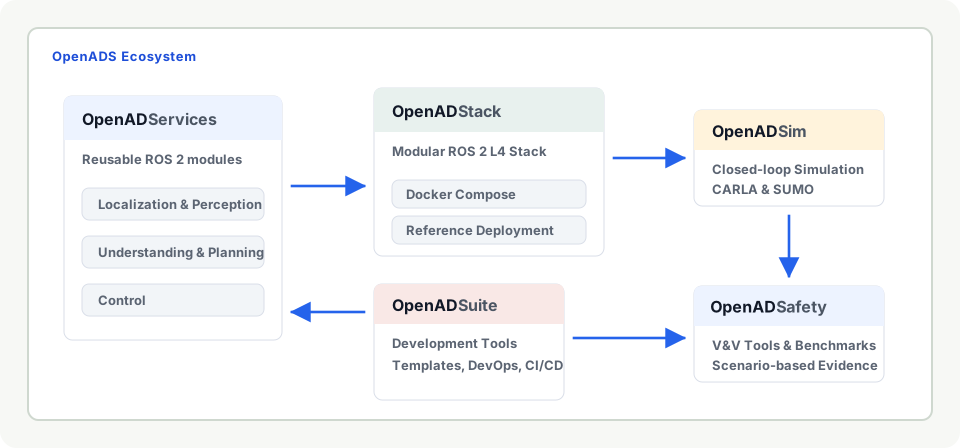
ROS-package-level modules can be developed independently while CI/CD keeps them integrated in the overall system.
Each module defines its dependencies and container image, so developers can start work without running the full stack.
Modular interfaces support evolving ADS architectures without restructuring the entire system.
Open CI tests and benchmarks make contributed modules easier to evaluate, compare, integrate, or remove.
Tutorial focus
The tutorial explains why collaborative OpenADS development matters, introduces the reference architecture and real-world applications, and concludes with a 50-minute hands-on session.
Why shared interfaces, reusable services, and reproducible evaluation are needed for open AD systems.
Relate functional architecture, integration architecture, and deployment composition to data, validation, and fleet-management use cases.
Take a guided tour through the core OpenADS repositories and then run OpenADSim before exploring scenario-based execution, module benchmarking, and metric calculation with an initial focus on perception.
2.5-hour program
Scope, learning objectives, and setup.
All organizersHow Ecosystem Mobility 4.0 enables collaborative OpenADS development across research and industry.
Timo Woopen, Thinking Cars GmbHFunctional architecture, integration architecture, and deployment composition: how reusable OpenADServices are assembled into the modular ROS 2 OpenADStack and embedded in vehicle or simulation setups.
Raphael van Kempen, RWTH Aachen UniversityThree examples of how OpenADS supports practical use cases.
A guided tour through the core OpenADS repositories and their relationships, followed by running and exploring OpenADSim. Building on this, participants are introduced to scenario-based execution and learn how modules can be benchmarked by calculating metrics, starting with publicly available perception modules and evaluation examples.
Christian Geller, RWTH Aachen UniversityLessons learned and next collaboration steps.
All organizersPractical setup
The tutorial is designed for intensive participant interaction. Motivation, architecture, and ecosystem applications frame the problem before participants work directly with OpenADS.
The 2.5-hour format keeps the tutorial compact and focused: a short setup, a motivation talk, an architecture overview, practical application examples, and a hands-on session.
The hands-on starts with a guided walkthrough of the core OpenADS repositories and then moves to running OpenADSim in a prepared environment. It then introduces scenario-based execution and a first benchmark workflow for calculating metrics on perception modules.
Researchers, engineers, suppliers, and industry stakeholders interested in OpenADS, supplier integration, service selection, simulation-based evaluation, and pre-development validation.
Faster integration, more transparent software selection, and reduced risk through reproducible cross-partner validation.
Organizing team
RWTH Aachen University
FZI Forschungszentrum Informatik
Thinking Cars GmbH
RWTH Aachen University
Starwit Technologies GmbH
FZI Forschungszentrum Informatik




Contact
Reach the organizing team at opensource@ika.rwth-aachen.de .